
People are changing the way they search for information. Instead of opening several websites and comparing pages manually, users can now ask AI platforms such as ChatGPT, Gemini and Google’s AI-powered search experiences to find information, compare options and recommend businesses.
For brands, this shift brings a new visibility challenge. Ranking well on Google remains important, but appearing in AI-generated recommendations is becoming an increasingly important part of digital marketing.
The important thing to understand is that there is no guaranteed trick that can make ChatGPT, Gemini or Google AI recommend a particular business. AI systems evaluate information from multiple sources and can produce different answers depending on the query, context and available information.
So, what can businesses actually do?
The answer is to build a strong digital presence that is easy to discover, understand, verify and trust.
What Does It Mean to Be Recommended by AI?
When someone asks an AI platform a question such as “Which digital marketing agency is best for a small business?” or “What are the best hospitality consultants in India?”, the system may generate an answer containing businesses, websites, products or sources.
Being recommended means that your brand has enough relevant and trustworthy information available online for an AI system to potentially identify it as a useful answer to a user’s question.
This is different from traditional SEO.
With traditional search, businesses generally compete for positions on a search results page. AI search can instead synthesize information from multiple sources and provide a conversational response.
That means brands need to think beyond individual keyword rankings and focus on entity clarity, topical relevance, authority, consistency and usefulness.
How Does AI Search Find and Understand Your Brand?
AI search systems do not rely on your homepage alone.
Information about a business can exist across its website, business profiles, reviews, industry publications, directories, social platforms and other trusted online sources.
Search engines and AI systems can use these signals to understand what a company does, who it serves and whether its information is relevant to a particular question.
For example, suppose a company describes itself as a digital marketing agency on its website but its business profiles describe it differently, its services are unclear, and there is very little independent information about the company.
An AI system may have less confidence about what the business actually specializes in.
This is why consistent and clearly structured information matters.
Google’s current guidance for AI search emphasizes foundational SEO practices such as crawlability, internal linking, useful content, textual information, good page experience and accurate structured data.
The AI Visibility Process
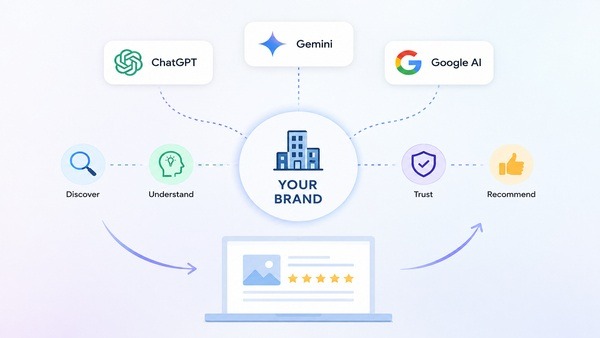
A useful way to understand AI visibility is to think about it as a four-stage process:
Discover → Understand → Trust → Recommend
1. Discover
AI systems need to be able to find your website and relevant information about your brand.
If important pages cannot be crawled or indexed, they have less opportunity to appear in search-driven experiences.
For ChatGPT Search, OpenAI specifically says websites should allow OAI-Searchbot to crawl their content to be eligible for inclusion. However, allowing crawling does not guarantee placement.
2. Understand
Your website should clearly communicate:
- Who you are
- What you offer
- Who you serve
- Where you operate
- What makes your business different
- Which topics you have expertise in
Clear headings, descriptive page titles, logical navigation and focused content help create this understanding.
3. Trust
Relevance alone is not enough.
AI-generated recommendations need reliable information. Genuine customer reviews, expert content, case studies, industry mentions and consistent business information can all contribute to a stronger digital footprint.
This does not mean businesses should manufacture mentions or reviews. Artificial signals can create the opposite of the trust a brand is trying to build.
4. Recommend
Once a brand is discoverable, understandable and supported by trustworthy information, it has a better foundation for being surfaced when its services are relevant to a user’s query.
But recommendation is never guaranteed. AI responses can change depending on the wording of the question, location, available sources and other contextual factors.

What You Need Before Optimizing for AI Search
Before creating dozens of new articles, businesses should first examine the foundation of their online presence.
Start with:
A Clear Brand Identity
Your company name, services, location and positioning should be clearly defined.
A Search-Friendly Website
Important pages should be crawlable, indexable, mobile-friendly and connected through logical internal links.
Useful Content
Create SEO content that genuinely answers customer questions rather than producing articles simply because a keyword has search volume.
Evidence of Expertise
Add original insights, practical examples, case studies, research, expert opinions and first-hand experience where appropriate.
Consistent Business Information
Make sure important business details remain accurate across relevant profiles and platforms.
This foundation is more valuable than trying to create a separate “AI trick” for every platform.
How to Build Content That AI Can Understand and Trust
Instead of writing one enormous article about digital marketing, for example, create a connected content ecosystem around important customer questions.
Instead of writing one enormous article about digital marketing, For example, marketers can also explore AI tools for digital marketing to support research, content planning and optimization.
A topic cluster could include:
- What Is SEO?
- How Does Local SEO Work?
- What Is GEO?
- GEO vs SEO
- How AI Search Works
- How to Optimize Content for AI Search
- How Businesses Can Build Topical Authority
- How Online Reviews Influence Brand Trust
The main pillar article should link to relevant supporting articles, while those supporting pages should link back to the pillar where appropriate.
This creates a clearer topical relationship for users and search engines.
It also gives your website multiple opportunities to demonstrate expertise rather than depending on one article.
Building a Strong AI-Ready Website
Technical SEO still matters when preparing a website for modern search experiences.
Google’s current documentation makes an important point: there are no special technical requirements or special schema types required specifically for AI Overviews or AI Mode. Existing SEO fundamentals remain important.
Focus on:
- Allowing search engines to crawl important pages
- Creating logical website architecture
- Using descriptive URLs
- Maintaining useful internal links
- Making important information available as text
- Improving mobile usability
- Maintaining good page experience
- Using structured data accurately where relevant
- Keeping business information updated
Do not treat schema as a shortcut to AI recommendations. Structured data should accurately represent visible information rather than being used to manufacture claims about your business.
How to Strengthen Your Brand’s Online Authority
AI visibility is not purely a website exercise.
Think about your entire digital footprint.
A stronger brand presence may include:
Website: Detailed services, expert articles, case studies and original insights.
Business profiles: Accurate information, categories, services and genuine reviews.
Industry publications: Relevant mentions, interviews, contributions or coverage.
Social platforms: Useful expertise rather than constant promotional messaging.
Third-party sources: Genuine references that establish your business within its industry.
The goal is not to create hundreds of random profiles.
The goal is to create a consistent web of legitimate information that makes your business easier to understand.
Best Practices for Getting Recommended by AI
Answer Specific Customer Questions
Create content around the questions your actual customers ask.
Demonstrate First-Hand Expertise
Generic information is easy to reproduce. Original experience is harder to replicate.
Add real examples, processes, observations, case studies and lessons learned.
Build Topic Clusters
Do not depend on one article. Build multiple useful pages around your core expertise and connect them with relevant internal links.
Keep Information Consistent
Your business name, services, location and positioning should not contradict each other across important platforms.
Update Important Content
AI and search environments change quickly. Review statistics, examples, recommendations and outdated information regularly.
Avoid AI-Generated FillerGoogle’s official documentation about generative AI content
Using AI to assist with research or drafting does not automatically make content valuable. Google emphasizes helpful, reliable, people-first content and warns against producing large amounts of low-value content simply at scale.
Do Not Chase Guaranteed Rankings
No agency or tool can honestly guarantee that ChatGPT, Gemini or Google AI will recommend a particular brand.
The better objective is to become a credible answer to the questions your audience is already asking.
Promotional Tips for Increasing AI Visibility
Once your content foundation is strong, promotion can help it reach more people and earn legitimate attention.
Share useful articles through relevant social channels, email newsletters and industry communities. Turn original research into statistics, short posts, videos or visual explanations.
You can also promote strong case studies and expert insights rather than publishing promotional posts about your company repeatedly.
The principle is simple:
Create something useful → distribute it → earn attention → build authority → strengthen your digital footprint.
Promotion should support your content strategy, not replace it.
How to Measure AI Search Visibility
AI visibility should not be measured only by asking whether your company appeared in one ChatGPT response.
Track broader signals such as:
- Organic search impressions
- Organic traffic
- Branded searches
- Website enquiries
- Leads and conversions
- Referral traffic
- Engagement
- Online brand mentions
- Visibility for important customer questions
Google has also introduced generative-AI performance reporting in Search Console, providing additional insight into visibility from Google’s AI search experiences.
For ChatGPT and other AI platforms, periodically test realistic customer questions and record how your brand appears over time. Treat these observations as directional rather than as a fixed ranking score.
Conclusion
Getting your brand recommended by ChatGPT, Gemini or Google AI is not about finding a secret optimization technique.
It is about building a business that is easy to discover, easy to understand and worth trusting.
Start with strong SEO fundamentals. Create original and useful content. Build topic clusters instead of isolated articles. Connect related pages with relevant internal links. Maintain consistent business information and earn genuine reviews, mentions and references.
Most importantly, focus on answering the questions your customers actually ask.
Google’s guidance makes clear that traditional SEO remains foundational for its AI search experiences, while OpenAI similarly notes that ChatGPT Search evaluates multiple factors and does not guarantee placement.
The future of search may be increasingly conversational, but the fundamental principle remains the same: brands that consistently provide useful, credible and original information have a stronger chance of being discovered wherever people search.
Frequently Asked Questions
1. Can I guarantee that ChatGPT will recommend my business?
No. There is no guaranteed method for securing a recommendation or specific placement. AI systems evaluate multiple signals and responses can vary depending on the query and context.
2. Does SEO still matter for AI search?
Yes. Google states that existing SEO best practices remain relevant for its AI search experiences. Technical accessibility, useful content, internal linking and good page experience continue to matter.
3. What is GEO?
GEO, commonly called Generative Engine Optimization, refers broadly to strategies intended to improve a brand’s visibility and representation in generative AI search experiences. It should complement rather than replace traditional SEO.
4. Does publishing more blogs improve AI visibility?
Not necessarily. Publishing large amounts of repetitive or low-value content is not a reliable strategy. A smaller collection of original, useful and well-connected content can be more valuable than dozens of generic articles.
5. How long does it take to improve AI visibility?
There is no fixed timeline. It depends on factors such as website authority, content quality, technical accessibility, competition, brand presence and how much reliable information exists about the business online.